
26 February, 2026
Are solar street lights worth it?
As energy prices continue to rise, grid stability faces growing challenges, and urban sustainability goals accelerate worldwide, more municipal decision-makers are re-evaluating how infrastructure investments are structured.
“Are solar street lights worth it?”
This question is not simply about upfront procurement costs. It is fundamentally a strategic decision about long-term risk management, energy independence, and Total Cost of Ownership (TCO).
This article analyzes whether solar lighting is a wise long-term investment from four perspectives: financial modeling, optimal application scenarios, operational reliability, and ESG alignment.
Understand TCO — Not Just Upfront Price
Many stakeholders hesitate when reviewing quotations: traditional grid-connected street lights often cost half as much as solar street lights. Why choose the more expensive option?
In the U.S. market, the procurement cost of a single solar street light typically ranges from $1,500–$4,000, including photovoltaic modules, LED fixtures, and battery systems. The upfront price is indeed higher than conventional lighting.
However, the true evaluation metric is total cost, not purchase price alone.
From an installation standpoint, solar street lights require no trenching, no underground wiring, and no grid connection approvals. Installation is straightforward and modular. Traditional street lights, by contrast, require trench excavation, permitting, and electrical infrastructure build-out—often resulting in installation costs three times higher than solar systems.
On electricity pricing, according to the “SunShot Initiative” proposed by the U.S. Department of Energy, utility-scale solar power generation costs have declined to approximately $0.03/kWh, while U.S. commercial electricity rates average $0.13–$0.15/kWh. Over time, grid-powered lighting carries electricity costs 5–6 times higher than solar generation.
From a maintenance perspective, solar street lights can support 10-year battery lifespans, eliminate electricity bills, and remove risks related to cable theft or frequent lamp replacements.
GODE solar street lights are engineered for longevity:
- Battery lifespan: 10 years
- LED lifespan: over 20 years
- Solar panels: more than 30 years of service life, maintaining over 80% performance
Below is a 5-year Total Cost of Ownership comparison for a single street light in a U.S. urban arterial road project:
| Project Costs | Solar Street Light | Traditional Street Light |
| Procurement | $3,000 | $1,500 |
| Installation | $500 | $3,500 |
| Electricity | $65 | $325 |
| Maintenance | $500 | $1,250 |
| Total(5-Year TCO) | $4,065 | $6,575 |
Additionally, solar systems benefit from economies of scale—the larger the deployment, the lower the overall cost per unit.
Where Solar Street Lights Offer the Strongest Advantage
Solar street lights demonstrate the greatest value in regions with high grid extension costs, unstable power supply, or elevated infrastructure resilience requirements.
Suburban Expansion or Limited Grid Coverage
In urban fringe expansion areas, the electrical grid is often not fully established. When a new main road or residential area is developed, traditional street lights require:
- Extension of the electrical grid
- Trenching and excavation
- Coordination with utility companies
- Multiple rounds of approvals
These steps increase costs and extend construction timelines.
Solar street lights operate as independent energy units and can be deployed directly according to urban planning layouts, significantly reducing construction complexity and capital expenditure.
Rural and Remote Areas
In remote regions, grid access can be difficult or cost-prohibitive. Solar street lighting reduces upfront infrastructure investment and eliminates ongoing electricity expenses while providing stable nighttime illumination.
Energy independence itself becomes a strategic asset in infrastructure-limited environments.
Parks, Pathways and ecologically sensitive areas
Traditional installations may disrupt green spaces or wildlife habitats. Solar street lights require no underground wiring and minimize environmental disturbance.
Many GODE models use warm-white LEDs, comply with dark-sky regulations, and incorporate motion sensors to balance energy efficiency with visual comfort.
Military Perimeters
In military or high-security zones, independence from external grids reduces vulnerability and ensures continued operation during emergencies.
Coastal Flood-Prone Areas
Flooding, storm surges, and salt corrosion present major risks to traditional grid-dependent systems.
Traditional street lights rely heavily on underground cabling systems. In the event of water ingress into these cables, damage to the electrical network, or flooding of substations, recovery can take a significant amount of time, and maintenance costs can be substantial.
In contrast, solar street lights eliminate underground cable risks and allow faster post-disaster recovery due to their independent structure.
As climate resilience becomes central to urban planning, coastal regions often see the strongest case for solar adoption.
Disaster-Prone Regions
In regions where natural disasters occur frequently, grid stability is severely challenged. Once a power outage happens, traditional street lights immediately stop functioning.
- Illumination of evacuation routes
- Access for emergency vehicles
- Maintenance of community security
For public safety, nighttime illumination is critical during emergencies:
In such environments, resilience outweighs cost considerations.
Performance and Reliability
Resilience Demonstrated in Extreme Environments
Not all solar lighting systems are built to the same standards.
GODE lighting systems are engineered to infrastructure-grade standards and purpose-built for harsh environmental applications. Whether facing high wind loads, heavy snow, corrosive conditions, or extreme temperature variations, the system maintains stable operation and energy independence.
From a structural performance perspective, the system withstands wind loads of 2400Pa and snow loads of 5400Pa; it passes TÜV salt spray and ammonia resistance testing, making it suitable for coastal and highly corrosive environments; the complete luminaire achieves IK10 impact resistance and IP66 ingress protection ratings, and operates reliably within a temperature range of -40°C to +55°C.
At the energy management level, the system integrates intelligent control algorithms with properly matched energy storage design. Even during consecutive cloudy or rainy days, it can maintain up to 36 hours of continuous lighting.
Responsible and Continuously Reliable Nighttime Lighting
Each GODE street light incorporates a secondary optical design, enabling LED light output to be precisely redistributed and focused onto the intended lighting area, maximizing light utilization efficiency.
Through optimized system design and intelligent management, energy generation, battery storage, and preset lighting configurations are carefully balanced. Even during prolonged cloudy conditions, the system maintains sustained illumination performance for up to 36 hours.
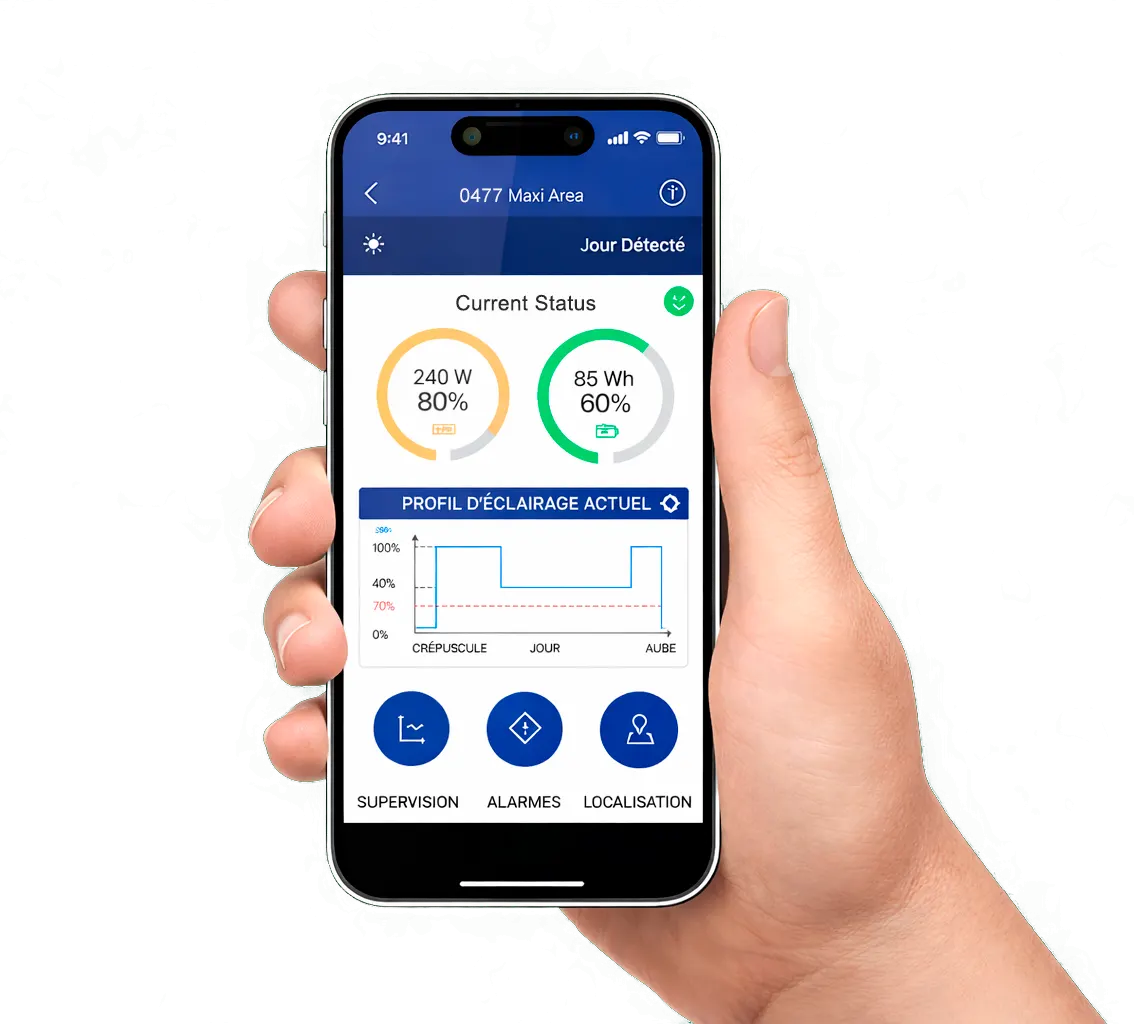
Remote Monitoring with the GODE Lighting APP
For large-scale solar lighting deployments, the GODE Lighting APP enhances operational intelligence and reliability.
From installation commissioning and performance monitoring to fault detection and alerts, intelligent lighting control, geospatial visualization, and region-based management, the platform enables comprehensive remote oversight—eliminating the need for manual, on-site inspections of each individual unit.
Energy Sustainability
Carbon Reduction
Solar energy represents clean power. Each installed solar street light offsets emissions generated by traditional grid-powered lighting.
According to the U.S. Environmental Protection Agency (U.S. EPA) eGRID national average emission factor, U.S. electricity generation produces approximately 0.394 kg CO₂ per kWh.
Using a 100 W street light as an example:
- Operating approximately 12 hours per day
- Operating approximately 365 days per year
- Annual electricity consumption = 0.1 kW × 12 h × 365 = 438 kWh/year
Based on the U.S. EPA emission factor, a traditional grid-powered street light would generate approximately 0.17 metric tons of CO₂ per year.
This clearly demonstrates that transitioning to solar lighting systems can significantly improve the energy structure of a project and deliver measurable long-term carbon reduction benefits.
Solar Incentive Policies
To encourage the adoption of clean energy, solar lighting systems are supported by substantial incentive programs.
In the United States, the Inflation Reduction Act (IRA) provides up to a 30% Investment Tax Credit (ITC) for eligible solar energy systems, with potential additional incentives for energy communities and domestic manufacturing.
For example, North Carolina offers a 35% state tax credit on the total cost of solar panel systems, while the federal government provides a 26% tax credit.
India also provides incentive programs covering photovoltaic applications such as solar rooftops and solar street lighting. The central and state governments jointly subsidize distributed solar systems in rural and remote areas, including solar lighting facilities.
Climate Compliance Trends
Globally, publicly listed companies are required to disclose carbon emissions data, public institutions face stricter ESG evaluations, and infrastructure financing is increasingly tied to sustainability metrics.
As a distributed clean energy system, solar lighting offers inherent advantages within this framework:
- Emission reductions can be directly quantified
- Easily integrated into carbon accounting systems
- Reduces long-term carbon liability risks
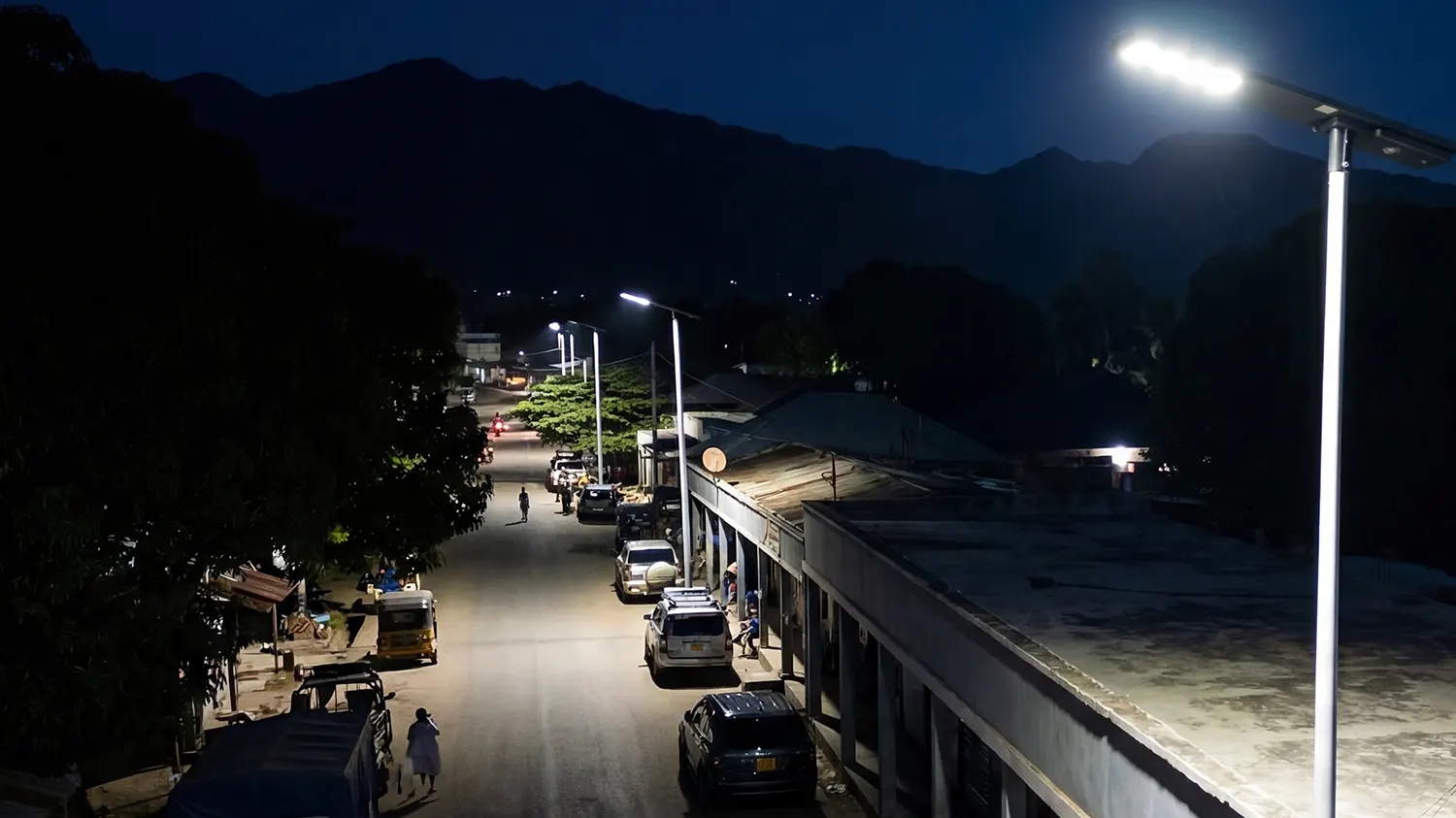
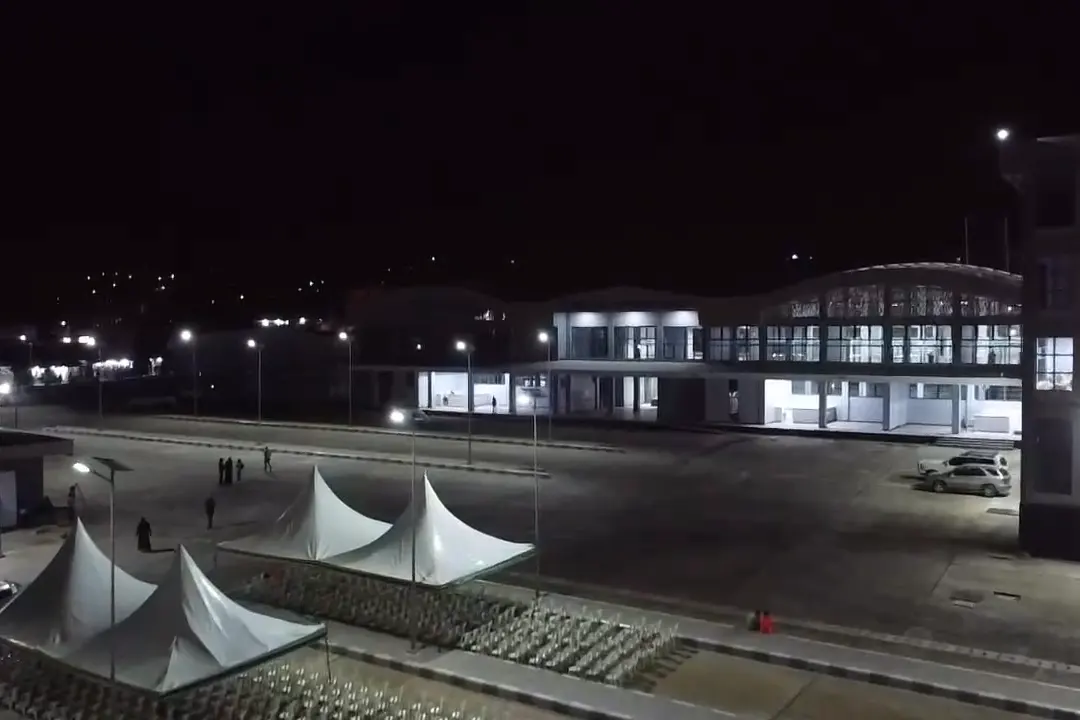
Building Independent and Stable Nighttime Lighting for a Public Bus Station
In a small town in Tanzania, limited grid coverage and high electricity costs resulted in long-term insufficient nighttime lighting at a local bus station.
By deploying GODE’s 0477 solar street lights, the project created a more independent and cost-effective public safety lighting solution, improving nighttime travel security at the bus station.
Conclusion
In regions with stable grids, low installation costs, and inexpensive electricity, traditional street lights may still present advantages
However, where grid expansion costs are high, disasters are frequent, ESG compliance is stringent, or energy independence is critical, solar lighting becomes not merely an option—but a strategic long-term infrastructure choice.
Ready to explore smarter lighting solutions for your next project?
Contact the GODE technical team for a complimentary customized feasibility assessment based on local meteorological data, electricity rates, and project scale.
Let every street light not only illuminate roads—but also power sustainable development for the communities they serve.
solar street lights FAQs
share

 EN
EN  FR
FR  PT
PT  DE
DE  ES
ES  AR
AR  VI
VI  ID
ID